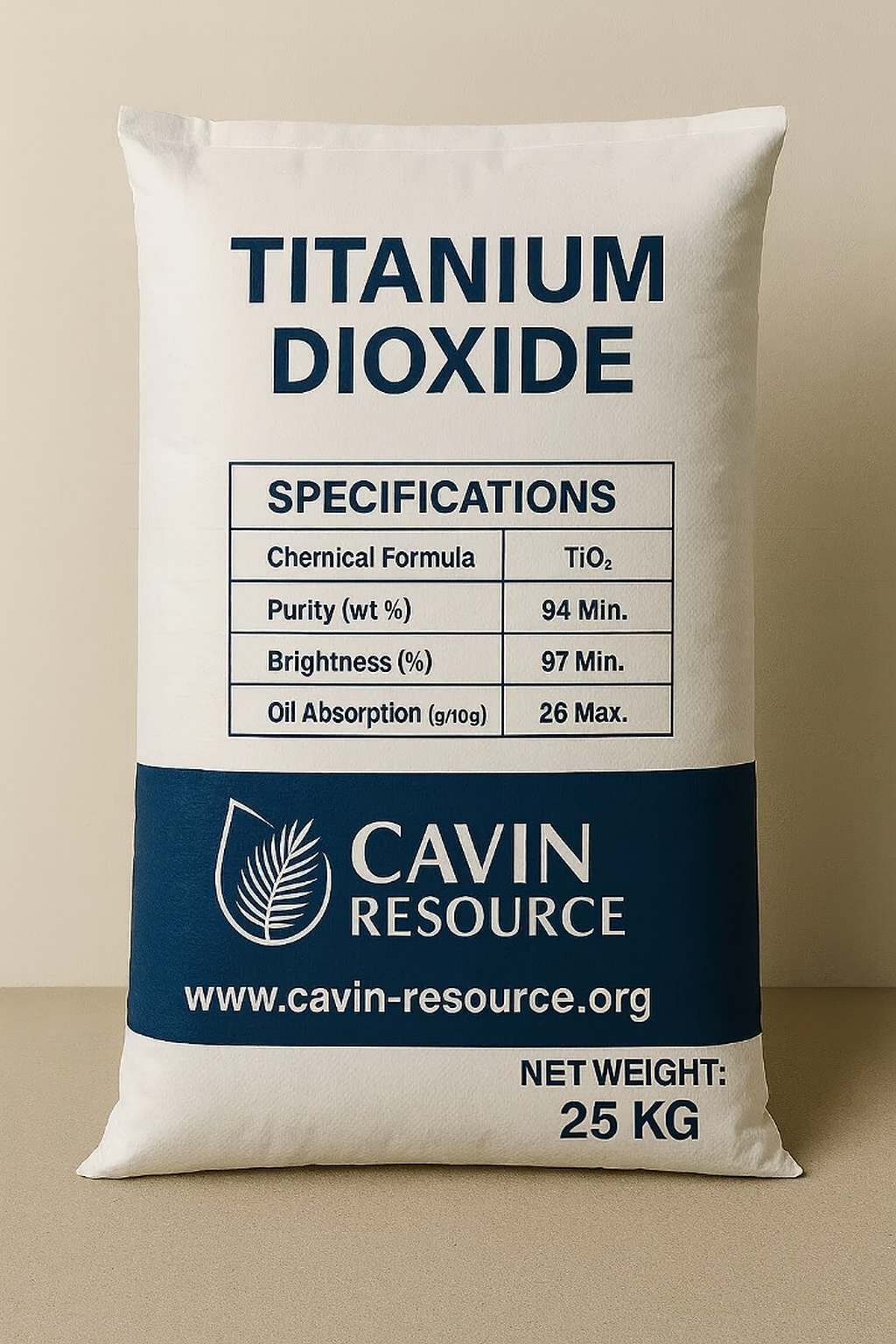
Titanium Dioxide, with the chemical formula TiO₂, is one of the most widely used white pigments in the world. Renowned for its brightness, high refractive index, and superior light-scattering properties, it delivers unmatched opacity and whiteness in products such as paints, plastics, paper, inks, ceramics, and sunscreens.
Cavin Resource offers bulk-grade titanium dioxide (Rutile and Anatase grades) tailored for both industrial and food-grade applications. Our TiO₂ is produced using chloride and sulfate processes, ensuring optimal particle size, purity, and dispersion. With global compliance and export capabilities, we are a trusted source for wholesale buyers and manufacturers worldwide.
1. Sulfate Process
-
Involves reacting ilmenite or titanium slag with sulfuric acid.
-
The product is then filtered, hydrolyzed, and calcined.
2. Chloride Process
-
Uses high-purity rutile or synthetic rutile.
-
Titanium tetrachloride (TiCl₄) is oxidized at high temperatures to form TiO₂.
-
Preferred for high-purity, low-impurity output.
🖌️ Paints & Coatings
-
Improves opacity, UV resistance, and durability in architectural, automotive, and marine coatings.
🧴 Plastics & Masterbatches
📄 Paper Industry
💄 Cosmetics & Personal Care
🍬 Food & Pharmaceuticals
-
🌟 Exceptional whiteness and brightness
-
🛡️ Superior UV blocking and opacity
-
♻️ Chemically stable and non-toxic
-
🧪 Versatile across industries: paints, cosmetics, plastics, food
-
🌍 Compliant with FDA, EU, REACH, and ISO standards
-
25 kg kraft bags (lined with PE film)
-
500 kg / 1-ton jumbo bags
-
Custom packaging on request
-
Full COA, MSDS, and export documentation included
1. What’s the difference between Rutile and Anatase TiO₂?
Answer: Rutile offers better UV resistance and opacity, making it ideal for coatings and plastics. Anatase is softer and more photoactive, often used in paper and certain cosmetics.
2. Is Titanium Dioxide safe for food or cosmetics?
Answer: Yes, food-grade TiO₂ (E171) is approved by major health authorities when used within set limits. We provide both industrial and food/cosmetic grades.
3. How can I determine the grade suitable for my application?
Answer: Cavin Resource provides technical support and product specification sheets to help you select the appropriate grade based on particle size, coating, and dispersion needs.
4. Is your Titanium Dioxide available for international shipping?
Answer: Yes. We handle global logistics, export paperwork, and custom clearance, ensuring seamless delivery.



Reviews
There are no reviews yet.